
 Adrián Pérez
 Valentina Herrero Casteigts
 Aurora Álvarez
Introduction
The right technology is the one that fits your people and your process, not the other way around. As digital transformation gains momentum, organizations often feel pressured to adopt solutions quickly, sometimes at the expense of evaluating what truly supports their operations. Not all processes require the same kind of digital solution. Some benefit from the speed and affordability of low-code/no-code platforms. Others are so standardized that they align well with a proven off-the-shelf system. And for highly complex or heavily regulated workflows, tailored solutions may be the only viable option. But no matter what kind of technology you choose, it’s also important to think about the people who will use it. If a system doesn’t support how your team works or what they need, it won’t succeed. Real progress comes when technology fits both the process and the people behind it.
The approach to digital transformation includes strategic decision making for what is the best platform for the type of business process that a company needs to transform. This piece looks at how digital solutions support digital transformation[1], using three case studies to show how different organizations have approached the choice between low-code/no-code platforms, off-the-shelf tools, and custom-built solutions. Additionally, we’ll dive into the importance of a strong data architecture and its critical role in the success of a digital transformation.
A User-Centered, Process-First Approach
Before selecting any software solution, whether Low-Code/No-Code, Off-the-Shelf or Tailored, it’s essential to first assess and optimize the underlying business processes it’s meant to support. Implementing a tool to automate a flawed process often results in faster inefficiency, not better outcomes. A more disciplined approach begins with understanding the value stream: identifying which steps create value for the customer and which do not. By eliminating non-value-adding activities, such as unnecessary handoffs, redundant approvals, or data re-entry, organizations can streamline operations before layering on technology. For instance, a company may be tempted to adopt a complex workflow platform to manage service requests, only to realize that with a few process adjustments and clearer roles, a much simpler tool would suffice. The best results come when cross-functional teams map out current processes, identify bottlenecks or waste, and design future-state workflows aligned with business goals. Empowering front-line teams to participate in this redesign ensures practicality and ownership. Only after this foundation is in place should the organization move forward with technology selection, choosing tools that support optimized, efficient workflows rather than just digitalizing broken processes.
The Pros and Cons
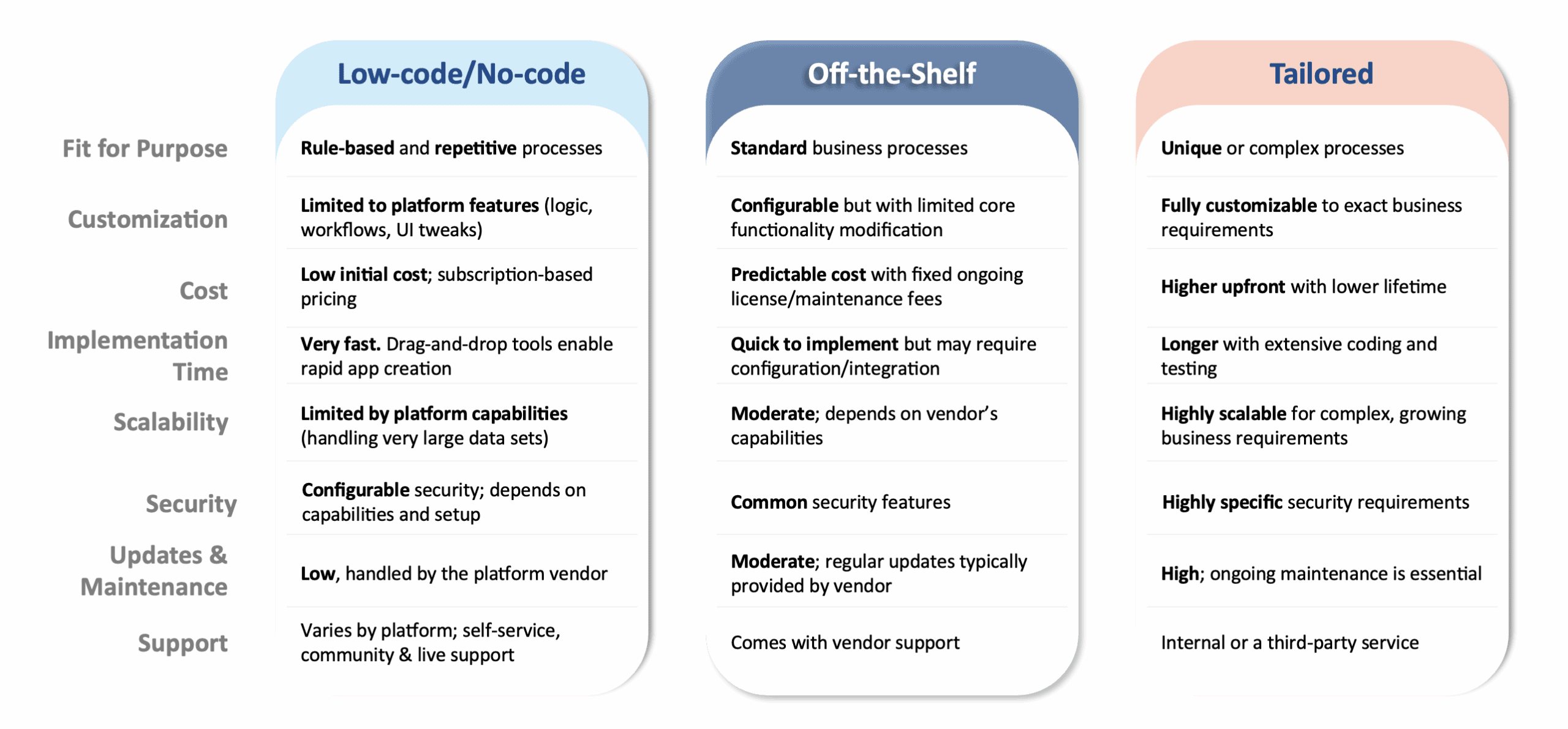
Learnings from Practice
Successful decision-making processes are essential to identify the tools that best fit an organization’s needs across diverse sectors. This section highlights an approach to evaluate organization’s current processes to determine the most suitable tools. It guides readers through three different scenarios that showcase the need for each type of solution.
Case 1: Implementing a Low-Code Platform to Support a State’s Agency New Vision for Preventive Maintenance
A State agency responsible for providing maintenance services to public buildings was facing criticism from its tenants because their buildings were reaching an alarming level of deterioration. Traditionally, the agency had deployed their maintenance crews to correct issues as they were reported (reactive or corrective). With new leadership in place, an approach to shift towards proactive or preventive maintenance was pursued, which required an external evaluation of processes and practices.
V2A’s first step in this transformation required a close look at current operations, and existing maintenance processes. With the identification of pain points and an alignment on the vision of a new process, the agency designed an improved preventive maintenance plan for each service offered (i.e. electricity, refrigeration, plumbing, amongst others). Subsequently, the new process was piloted to validate and confirm the expected outcomes, and before a digital tool was set in motion.
Once the preventive maintenance process proved effective, the agency began the process of selecting a digital solution to streamline daily work and enhance transparency. Because many tasks were repetitive, a low-code platform was proposed for its speed of implementation and cost efficiency. Agency staff was able to contribute to the selection process, making sure that the solution was aligned with their daily routine, and in parallel, helped the agency garner a sense of ownership over the new system – promoting adoption across the organization.
Ultimately, the tool included a detailed portfolio of each building, enabling maintenance to be tailored to specific needs. This low-code solution was the best fit, offering the right balance of flexibility and affordability. Off-the-shelf software would have required out-of-budget license costs, while a tailor-made solution, though flexible, required longer implementation time and higher upfront costs.
With the new standardized preventive maintenance process and digital support, corrective work orders were reduced by ~80%, while a ~50% increase in property visits helped ensure more consistent upkeep and improved overall infrastructure condition. This success also shifted employee mindset from reactive to proactive maintenance.
Case 2: Maximizing Procurement for a Utilities Company Using an Off-the-Shelf Tool
In supporting an energy generation company seeking to optimize their procurement process, the option to depart from existing systems was evaluated. Although the organization was already using an industry-specific off-the-shelf tool, their ongoing process challenges prompted a closer look, to ensure the tool was satisfying all user requirements and not contributing to their existing inefficiencies.
To determine which type of procurement software best suited the company, a comparative assessment was conducted by identifying the organization’s essential features. These priorities then formed the basis for evaluating the effectiveness of their existing off-the-shelf tool compared to tailored procurement solutions. A Low-code platform was not considered due to the complexity of their operations, including large data sets as well as industry and regulatory demands that this simple solution would not be able to support.
The analysis revealed that their current tool already offered core functionalities that would be difficult to replicate in a tailored solution, including industry-specific requirements and regulatory demands. The turning point of our analysis was discovering that the organization had not fully leveraged the tool’s capabilities as several existing features aligned closely with their desired functionality but had not yet been incorporated into their daily operations. Implementing a tailored solution would have required significantly more time to configure these capabilities and regulations, making it an impractical choice given the urgency of their needs and limited budget.
Their primary challenges were not rooted in the procurement software itself but in inefficiencies within the process and gaps in management infrastructure and capabilities. Based on these findings, the recommendation was to continue using their off-the-shelf tool and focus on maximizing its utilization to support their operations.
Case 3: Transforming a Government Agency through Centralization and Digitalization with a Tailored Tool
A state’s central procurement agency needed to address a significant challenge: centralizing buyers from over 50 local agencies into a single entity while increasing transaction volume fivefold (5X). With a basic level of digital maturity[2] and a paper-intensive procurement process, inefficiencies were extensive.
To tackle this, the agency's complex workflows and processes were optimized using a Lean Management framework, governed by ever-evolving government regulations, and developed a tailored, highly customizable tailored solution to meet the increase in demand, and digitalize the entire process. Starting with a Minimum Viable Product (MVP), the tool was continuously refined over three years by incorporating user feedback and leveraging new technologies to ensure alignment with operational demands.
The results spoke for themselves. By the third year of implementation, the agency achieved its fivefold transaction volume increase using the same number of full-time employees as when the solution was launched. Processing times also dropped by more than 70% for over half of the purchases, demonstrating the transformative impact of this tailored solution.
This experience highlighted the limitations of off-the-shelf and low-code tools for complex processes. While low-code platforms offer speed and ease of use, they lack the deep customization needed to handle detailed workflows and changing state regulations. A fully customized platform enabled seamless adjustments to these specific requirements, providing the flexibility and efficiency that off-the-shelf and low-code solutions could not match.
All three cases demonstrate the diverse challenges that could be faced when evaluating digital solutions. These experiences demonstrate that no type of technology is inherently superior to another; rather, success depends on choosing a digital solution that best aligns with and supports a predefined optimal process and the organization’s people. Regardless of the scenario, the decision-making process should consider the right pros and cons to determine the solution that best meets an organization’s unique needs.
Conclusion
All in all, the key to a successful digital transformation lies not in choosing a one-size-fits-all solution, but in selecting the technology that best accommodates your organization’s unique processes and people. Whether it’s a low-code/no-code platform, an off-the-shelf system, or a tailored solution, the foundation of success is a process-first approach that enables operational excellence. By making informed decisions and prioritizing a sustainable digital strategy, an organization can unlock greater digital maturity and maintain a competitive edge in today’s rapidly evolving landscape.
Afterword: The Importance and Impact of a Strong Data Architecture
The true value of any digital solution - low-code/no-code, off-the-shelf or tailored - relies on the foundation of a robust data architecture to support seamless access and future analytics solutions. Well-organized, accessible and reliable data empowers organizations to make informed decisions and enables operational excellence. Data has become one of the most critical assets for businesses, providing leaders with a strong foundation to drive growth and success. This is why no digital transformation can be considered truly successful without the integration of strong data architecture. A well-designed data architecture enables businesses to fully leverage integrated systems for predictive modeling, process automation, and optimization, thereby unlocking significant value within the data ecosystem. It also supports advanced tools such as Tableau, Power BI, and statistical software, empowering organizations to generate actionable insights, comprehensive reports, and interactive dashboards.
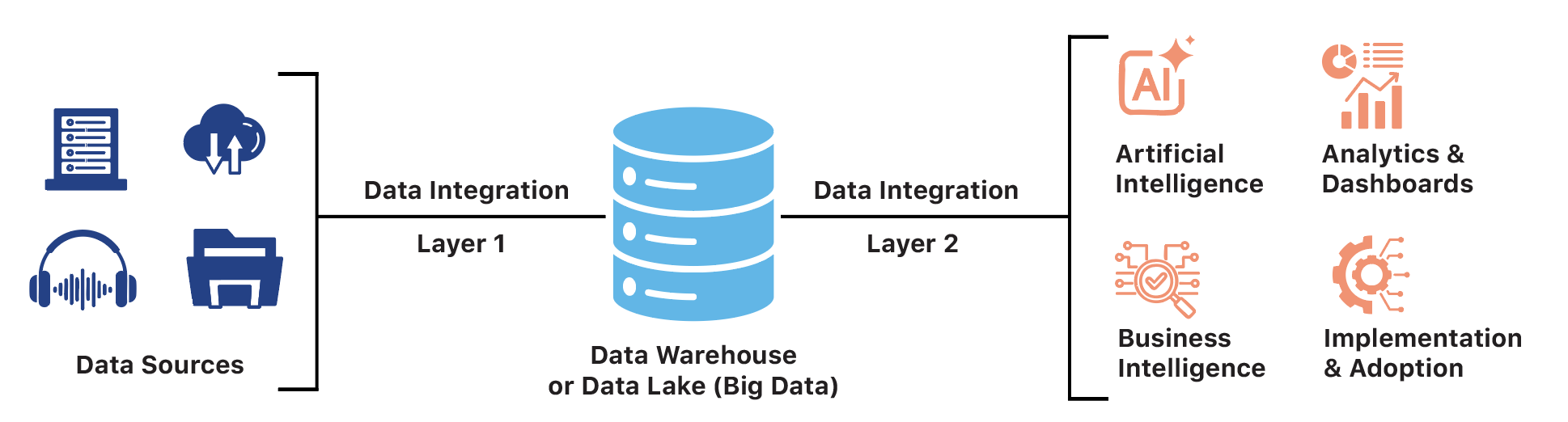
Figure B: Data Architecture
Ultimately, without a strong data architecture, business leaders lack the visibility need to assess their operations effectively and identify opportunities for continuous improvement, hindering their ability for innovation and maintaining a competitive advantage, defeating the whole purpose of digital transformation.
Appendix
Data Sources: These include structured data (e.g. databases) and unstructured data (e.g. images, videos, audio).
Data Warehouse: Used for storing structured, cleaned and processed data, often used for business reporting and dashboards.
Data Lake: Used for raw, unprocessed data (structured, semi-structured, or unstructured) from multiple sources to leverage analytics, machine learning, and advanced data processing.
Data Integration Layers
Layer 1: Extracting and transforming raw data from sources into standardized formats.
Layer 2: Organizing and modeling data for specific use cases, enabling applications like dashboards, AI, and advanced analytics.
References:
[1] Digital Transformation: How to get it right
[2] Unlocking Digital Maturity: A Data-Driven Digital Transformation Strategy