< Regresar a Insights

Analítica para Negocios y Mercado

Analítica para Negocios y Mercado


PR Banking Industry Report Q2 2020

Reduction in profitability in the first half of 2020 (7.0% Pre-Tax ROE) vs 2018 and 2019 due to lower interest margin and fee income, and higher loan loss provision, mostly driven by the Covid pandemic and its impact on the local and US economies. Despite the magnitude of the pandemic impact, no bank had negative net income, with Popular reaching the highest pre-tax ROA (0.97%), followed by Oriental (0.68%), Santander (0.58%), and FirstBank (0.40%).

PR Banking Industry Report Q1 2020

The impact of Covid-19 has been partially absorbed by local banks in their Q1 2020 results through a significant increase in loan loss provision. However, the reduction in fees and transactional income was small (last two weeks of March 2020) and will be felt mostly in Q2 2020 and in subsequent quarters depending on the pace of return to normal economic activity. In this Q1 2020 Banking Industry Report we present a brand new format where the user will be able to select particular periods of time and banks to review key metrics trends and make bank comparisons.

Informe de V2A sobre la banca de RD - 1er Trimestre 2020

El impacto de la crisis global de salud en el sistema financiero del país será significativo, y en este Insight se compara con las dos últimas crisis financieras (2003 y 2008), y se estima que sectores económicos se verán afectados y que acciones deben tomar las instituciones financieras ante este panorama

Unemployment Claims Reach Historic Highs following the COVID-19 Lockdown

The deep economic effects of Covid-19 are reflected in the unprecedented rise of unemployment claims around the world. In Puerto Rico, cumulative unemployment claims in the five weeks following the lockdown reached 200,419, three times the total claims during 2019. This number is in line with the US when measured in relation to the labor force. Covid-19 is also impacting the large informal economy of the Island, which is not eligible for unemployment insurance. On the other side, Puerto Rico may be seen as a safe place to do business given the successful containment of the virus so far, and as an ideal location from where to work remotely in the future.

Compare mobility trends and positive cases in Puerto Rico and other Countries/States

Mobility restriction measures have the objective of reducing the contagion of Covid-19. The V2A Covid-19 Mobility Dashboard compares mobility reductions/increases with the spread of Covid-19 in all States of the US and more than 100 countries including Puerto Rico. Several Countries/States can be selected to compare mobility in various sectors/areas (Retail and Recreation, Grocery and Pharmacy, Parks, Residential, Workplace, Transit Stations) and the evolution of positives per 100k population on a daily basis.

Medidas económicas para hacer frente a los efectos del Covid-19: comparación entre República Dominicana y otros países

La crisis del COVID-19 ha hecho que los países activen todo tipo de protocolos. Además de las medidas sanitarias tomadas desde el inicio de la Pandemia, se han empezado a aplicar otro grupo de medidas destinadas a compensar el impacto económico en los diversos sectores de la sociedad. En este análisis comparamos las medidas económicas tomadas en la República Dominicana y en una selección de países de Latinoamérica y Europa

PR Banking Industry Report Q4 2019

The local banking industry has gone through a profound and long-lasting consolidation process since 2010, with only three remaining banks surviving, Popular, FirstBank, and Oriental. With this consolidation came a steep decline in assets, deposits, and loans. From 2009 to 2016, total banking assets decreased by 38% or $34.9 billion, deposits by 24% or $14.4 billion, and loan portfolios by 38% or $23.5 billion. However, 2016 seems to be a turning point in the financial condition of local banks with assets increasing by 21%, deposits by 33%, and loans by 8% during the 2016-2019 period. The banks that have survived the latest wave of consolidations exhibited a strong financial performance in 2019, posting a consolidated Pre-Tax ROE of 13.7%. Their productivity, credit quality, and capital position in 2019 were solid and moving in the right direction, posting a cost-to-income ratio of 57.9%, a nonperforming loans ratio of 5.0%, and a Tier 1 Risk-Based Capital Ratio of 21.0%. Looking into the rest of 2020, the banking sector will likely benefit greatly from the imminent inflow of $8.285 billion in Community Development Block Grant Mitigation (CDBG-MIT) funds which have been made available by the Department of Housing and Urban Development (HUD), after months of delay. Additionally, new Current Expected Credit Losses (CECL) regulations will likely have material operational implications as well as financial ones.


Informe de V2A sobre la banca de RD - Enero a Septiembre 2019

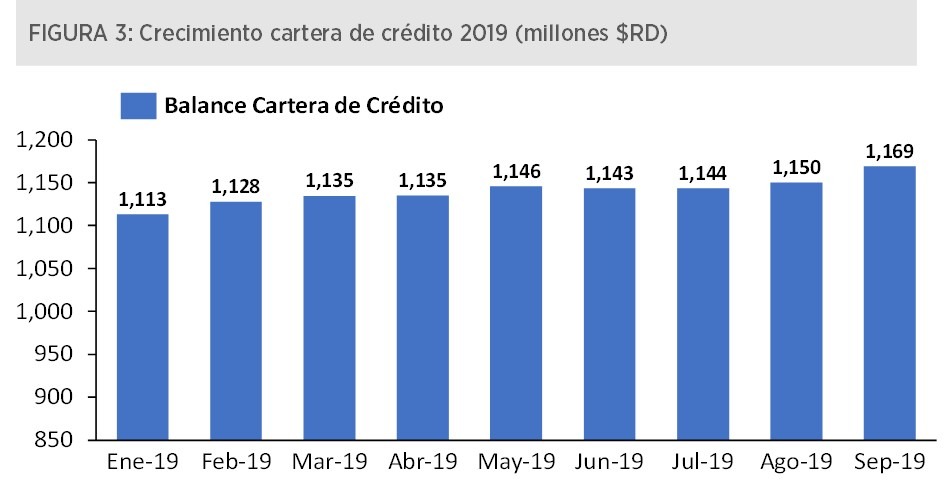
El primer semestre del año 2019 se caracterizó por una ralentización de la economía en República Dominicana con un crecimiento del Índice Mensual de Actividad Económica (IMAE) de 4.7% contra el primer semestre de 2018, inferior al 7.0% registrado en el año 2018 contra el 2017. Los meses de septiembre y octubre de 2019 mostraron un aumento interanual del IMAE de 5.2% indicando un nuevo repunte de la actividad económica después de las políticas monetarias expansivas del banco central (reducción de la tasa de intercambio y de la tasa de encaje legal). Estas medidas están a tono con el nivel de inflación acumulada de enero a noviembre que se situó en 3.45% y que se encuentra dentro de la meta de inflación del Banco Central de la República Dominicana. La mejora de la actividad económica vino acompañada de un aumento de 1.7 puntos porcentuales de la rentabilidad de la banca múltiple representada por el TOP 5 en el periodo de enero a septiembre de 2019 con respecto al 2018.

Scroll al inicio